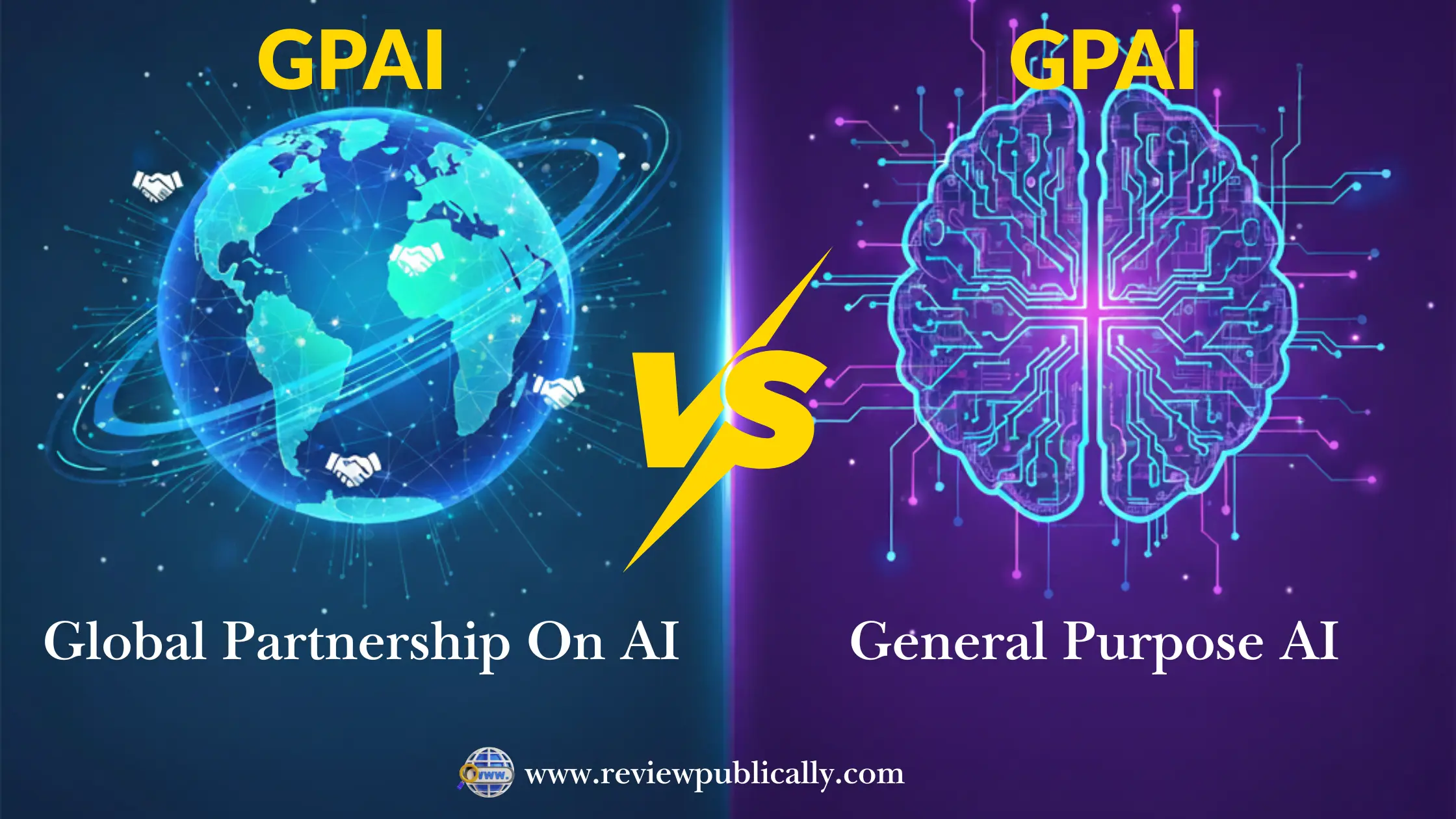
GPAI: Global Partnership on AI Explained — Members, Mission & 2025 Updates
// outline
Quick Answer: What Is GPAI?
GPAI (Global Partnership on Artificial Intelligence, pronounced “gee-pay”) is an international, multistakeholder initiative comprising 46+ member countries and the European Union, founded in June 2020, that promotes the responsible development and use of AI grounded in human rights, inclusion, and the OECD AI Principles. It is hosted by the OECD in Paris and operates through four Working Groups: Responsible AI, Data Governance, Future of Work, and Innovation & Commercialisation. In July 2024, GPAI merged with the OECD’s AI policy work to create a unified integrated partnership. Serbia chairs the GPAI Council for 2025.
What Is GPAI? A Full Explanation
The Global Partnership on Artificial Intelligence (GPAI) is a voluntary, non-binding international initiative that brings together governments, industry, civil society, and academic experts to promote responsible AI development aligned with democratic values, human rights, and economic growth. Its legal character is that of a partnership rather than a treaty organisation — membership implies political commitment to the OECD AI Principles, not legally enforceable obligations.
GPAI fills a specific gap in the global AI governance landscape: it is the primary multistakeholder international forum where experts from outside government (industry, academia, civil society, trade unions) participate alongside government representatives on a meaningful, structured basis — not as observers at a diplomatic table, but as working group members who shape substantive outputs.
The partnership’s core objective, as stated in its Terms of Reference, is to “bring countries and experts together to support and guide the responsible adoption of AI grounded in human rights, inclusion, diversity, gender equality, innovation, economic growth, and environmental and societal benefit, while seeking to contribute concretely to the 2030 Agenda and the UN Sustainable Development Goals.”
GPAI History: From G7 Proposal to OECD Integration
Proposal at G7 Charlevoix Summit ORIGIN
Canadian Prime Minister Justin Trudeau and French President Emmanuel Macron jointly propose an international study group on AI at the 44th G7 Summit in Charlevoix, Canada. The concept is modelled loosely on the Intergovernmental Panel on Climate Change (IPCC) — a body that brings together scientific experts to inform international policy on a global challenge. Leaders endorse the idea of a values-based international AI initiative.
OECD AI Principles adopted FOUNDATION
The OECD adopts the OECD Recommendation on Artificial Intelligence (the OECD AI Principles) on 22 May 2019 — the first intergovernmental standard on AI adopted internationally. These five principles — inclusive growth, human-centred values, transparency, robustness, and accountability — become the foundational framework on which GPAI is built. G7 leaders later endorse the principles at the Biarritz Summit.
GPAI officially launched with 15 founding members LAUNCH
GPAI is formally established on 15 June 2020 with 15 founding members: Australia, Canada, France, Germany, India, Italy, Japan, Mexico, New Zealand, the Republic of Korea, Singapore, Slovenia, the United Kingdom, the United States, and the European Union. The OECD hosts the dedicated secretariat in Paris. France hosts the inaugural GPAI Summit in December 2020. UNESCO joins as an observer.
Membership expands to 25 countries GROWTH
In November 2021, Czechia, Israel, and several more EU countries join GPAI, bringing total membership to 25. The Working Groups expand their scope to include dedicated streams on AI and Pandemic Response (a direct COVID-19 response initiative) and AI and Climate Action under the Responsible AI group.
Tokyo Summit & membership reaches 29 EXPANSION
Japan hosts the 2022 GPAI Summit in Tokyo. Membership grows to 29 countries, adding Argentina, Brazil, and Senegal among others — a significant expansion toward the Global South. The New Delhi Declaration process begins with India preparing to assume the rotating chairmanship.
New Delhi Summit & India’s chairmanship MILESTONE
India chairs GPAI in 2023 and hosts the GPAI Summit in New Delhi from 12–14 December 2023. The New Delhi Declaration is adopted, advancing initiatives on collaborative AI for the Global South and establishing a framework for governing generative AI. The G7’s Hiroshima AI Process is also launched, with GPAI and the OECD playing a central supporting role in establishing the first international framework and code of conduct for advanced AI systems.
OECD-GPAI integration announced MERGER
In July 2024, the OECD Secretary-General announces that GPAI will merge with the OECD’s AI policy work to create an integrated partnership under the GPAI brand. This brings 44 countries across six continents together on equal footing. The Belgrade Ministerial Declaration is adopted in December 2024 under Serbia’s incoming chairmanship, reaffirming commitments and setting 2025 priorities.
Serbia chairs GPAI; expanded partnership active CURRENT
Serbia holds the GPAI Council Chair in 2025. The integrated GPAI-OECD partnership now encompasses 46+ member countries and the EU across six continents. The Hiroshima AI Process Reporting Framework launches in February 2025. The India AI Impact Summit Council meeting occurs in New Delhi in February 2026. GPAI continues work on generative AI governance, AI safety, and AI for the Global South.
GPAI Member Countries in 2025
GPAI comprises 46+ member countries and the European Union as of 2025–2026. The original 15 founding members are highlighted in blue. Membership requires commitment to the OECD Recommendation on AI and a demonstrated proactive role in advancing responsible AI.
GPAI Governance Structure
GPAI operates through a layered governance structure designed to separate high-level political direction from expert technical work:
| Body | Composition | Role | Meeting frequency |
|---|---|---|---|
| GPAI Council | Ministerial-level representatives + senior stakeholders from business, civil society, trade unions, technical community | Strategic direction, membership decisions, high-level priorities. Holds ultimate decision-making authority. | Regular meetings; annual ministerial |
| GPAI Plenary | All member country representatives + observers (business, civil society, international organisations) | Primary working body: AI governance discussion, endorsing policy outputs, approving work programme, deciding new members | Twice per year |
| Steering Group | Subset of interested member countries + EU + business, civil society, Centres of Expertise | Prepares proposals for Plenary, coordinates between meetings, shapes work programme | Regular (between Plenaries) |
| Multistakeholder Expert Group (MEG) | Experts from government, industry, civil society, academia, international organisations serving in individual capacity | Develops Working Group outputs, Annual Reports; bridges theory and practice on AI | Working Group basis |
| OECD Secretariat | OECD professional staff in Paris | Administrative and analytical support; maintains OECD.AI Policy Observatory; coordinates with G7 Hiroshima Process | Continuous |
// the rotating Chair system gives each GPAI Council Chair a one-year term as Lead Chair, with Outgoing and Incoming Chairs in parallel. Serbia (Lead, 2025), India (Outgoing), and the 2026 incoming Chair form the current troika as of 2025.
GPAI’s 4 Working Groups: What Each One Does
The substantive work of GPAI is produced by four thematic Working Groups, supported by Centres of Expertise in Montreal (CEIMIA) and Paris (INRIA):
The broadest and most active Working Group, covering AI ethics, bias, fairness, safety, transparency, and accountability across AI systems. In 2023–2025, it has expanded to include dedicated sub-streams on AI and Pandemic Response, AI and Climate Action, and generative AI governance. It also feeds into the G7 Hiroshima Process on Advanced AI Systems.
Addresses the standards and practices for responsible data use in AI development: data quality, data sharing frameworks, privacy-preserving techniques, and the governance of datasets used to train AI models. Increasingly relevant as the EU AI Act and other regulations impose data documentation requirements on high-risk AI systems.
Examines how AI is transforming employment, skills, and labour markets globally. The “Living Lab” initiative demonstrates practical study of AI’s impact in real workplace contexts. This Working Group provides the research basis for informed labour market policy responses to AI automation, complementing the WEF Future of Jobs Report analysis.
Focuses on enabling AI innovation while managing associated risks: startup ecosystems, intellectual property in AI, open-source AI governance, AI procurement standards, and the commercialisation of research. Balances the innovation-focused interests of GPAI members with the governance agenda of the Responsible AI group.
How GPAI Actually Produces Outputs
Understanding GPAI’s process helps explain why it operates on a longer timeline than direct regulatory bodies:
Working Group formation and scoping. The Steering Group identifies priority themes for each annual work programme. Experts from the Multistakeholder Expert Group are convened in Working Groups aligned to one of the four thematic pillars.
Research and applied projects. Working Groups conduct research, run pilot projects with willing governments and organisations, and produce analyses on AI-related issues. The Centres of Expertise in Montreal and Paris provide technical and administrative backbone.
Multistakeholder Expert Group review. Working Group outputs are reviewed by the full MEG, adding cross-disciplinary perspective and ensuring outputs are not dominated by any single sector or geographic viewpoint. Annual Reports are developed at this stage.
Steering Group preparation. The Steering Group prepares outputs for Council and Plenary consideration, coordinates between Working Groups, and provides guidance to the Secretariat.
Plenary and Council endorsement. The Plenary (twice yearly) and Council (ministerial meetings, typically annually) discuss, refine, and endorse outputs. Declarations are adopted at annual summits.
Publication and implementation support. Endorsed outputs — frameworks, reports, recommendations — are published on OECD.AI and provided to member governments as policy guidance. GPAI does not enforce implementation but supports it through technical assistance.
The 2024 GPAI-OECD Integration: What Changed
The July 2024 announcement that GPAI would integrate with the OECD’s AI policy work was one of the most significant structural developments in international AI governance of the decade. Understanding what changed — and why — is essential to understanding GPAI in 2025.
Why the merger happened
According to Brookings Institution analysis, GPAI struggled with three structural challenges in its first four years:
- Governance concentration — practical control of Working Groups rested with the two founding countries (Canada and France, through CEIMIA and INRIA), leaving other member countries with limited agency and ownership
- Budget instability — reliance on voluntary contributions created funding uncertainty that constrained the scope of Working Group activities
- Mission clarity — overlap with the OECD’s own AI work, the G7 Hiroshima Process, and other governance bodies created duplication without clear differentiation of GPAI’s unique value
What the integrated partnership changed
- Equal footing for all members. GPAI member countries now participate on an equal basis, reducing the structural dominance of founding countries in Working Group operations
- Expanded membership. The merger brought OECD member countries and GPAI countries together, expanding the partnership to 44–46+ states across six continents
- Stable institutional infrastructure. Integration into the OECD provides access to stable budget, institutional expertise, and the OECD.AI Policy Observatory platform
- Reduced duplication. GPAI’s expert community and the OECD ONE AI expert network are now merged, reducing parallel structures and increasing research impact
- Stronger G7 connection. GPAI now plays a more central role supporting the Hiroshima AI Process, which represents the G7’s primary framework for advanced AI governance
Key GPAI Declarations & Summits
The first GPAI Summit, hosted by France in December 2020, formally launched the partnership’s operational activities. France and Canada presented their vision for GPAI as an international body that could provide independent, expert guidance to governments on AI policy — analogous to how the IPCC provides scientific guidance on climate change. The summit established the governance structure, confirmed the four Working Groups, and set the initial work programme.
Japan hosted the 2022 summit, at which GPAI membership expanded to 29 countries with the addition of Argentina, Brazil, Senegal, and others. This summit was significant for GPAI’s strategic shift toward greater Global South representation, a recurring theme that would deepen at subsequent summits. Japan also advanced work on the upcoming G7 Hiroshima AI Process during its G7 presidency.
India’s chairmanship culminated in the GPAI Summit in New Delhi (12–14 December 2023), where the New Delhi Declaration was adopted. India’s presidency focused on two priorities: collaborative AI for the Global South (reflecting India’s concern that AI development was dominated by wealthy nations) and generative AI governance. The declaration also advanced the G7 Hiroshima Process, establishing the first international framework and code of conduct for advanced AI systems, with the “Friends of the Hiroshima Process” expanding to 53 countries.
The OECD Secretary-General announced the formal integration of GPAI and OECD AI policy work in July 2024. This structural change addressed the governance, budget, and mission clarity challenges that had constrained GPAI, while adding six non-OECD member countries to the OECD’s AI work and establishing a more inclusive, equal-footing governance model for all member countries.
The Belgrade Ministerial Declaration, adopted in December 2024 under Serbia’s incoming chairmanship, set the agenda for GPAI’s integrated partnership in 2025. It reaffirmed commitments to human-centric, trustworthy AI, advanced the work on generative AI safety and governance, and highlighted GPAI’s role in supporting developing economies’ AI capacity-building.
The Hiroshima AI Process Reporting Framework, co-developed by GPAI and the OECD, was launched in February 2025. This framework encourages voluntary transparency and accountability among organisations developing advanced AI systems, facilitating comparability of risk mitigation measures across developers. It represents one of the most concrete governance outputs GPAI has contributed to, translating principles into practical reporting guidance for frontier AI labs.
GPAI vs Other International AI Governance Instruments
GPAI is one of several international AI governance mechanisms operating simultaneously. Understanding how they differ prevents confusion:
| Instrument | Type | Binding? | Scope | GPAI relationship |
|---|---|---|---|---|
| GPAI | Voluntary partnership | No | Global (46+ countries) | — This is GPAI |
| OECD AI Principles | Intergovernmental standard | Non-binding recommendation | OECD + adhering countries | GPAI’s foundational framework; GPAI operationalises these principles |
| EU AI Act | Binding regulation | Yes (EU) | European Union only | Complements GPAI; translates some principles into law; GPAI experts informed its development |
| G7 Hiroshima AI Process | Political framework | Voluntary | G7 + 53 “Friends” | GPAI and OECD are primary technical support organisations |
| UN Global Digital Compact | Political declaration | Non-binding | Global (UN members) | Complementary; broader digital governance scope; GPAI contributes AI-specific expertise |
| AI Safety Institutes (US, UK, EU) | National/regional bodies | Varies by jurisdiction | National | Bilateral coordination; GPAI provides multilateral forum; AI Safety Institutes provide binding evaluation |
| ISO/IEC AI standards | Technical standards | Voluntary (often industry-adopted) | Global | GPAI outputs sometimes feed ISO/IEC standards processes; technical standards complement policy guidance |
GPAI’s Concrete Achievements in 2020–2025
Beyond its diplomatic and governance value, GPAI has produced substantive outputs that have influenced global AI policy:
- Responsible AI guidance — GPAI’s Responsible AI Working Group produced foundational guidance on AI transparency, algorithmic accountability, and AI fairness that has been cited in national AI strategies across multiple member countries
- Hiroshima Process Reporting Framework — co-developed with the OECD, this is the first international framework requiring AI developers to voluntarily report on safety measures, risk mitigation, and model capabilities in a comparable format
- AI Incident Taxonomy — GPAI contributed to the OECD’s AI Incidents and Hazards Monitor (AIM), which documents AI incidents globally to help policymakers and practitioners understand emerging risks
- Generative AI governance framework — the New Delhi Declaration advanced principles for governing general-purpose AI models, feeding directly into EU AI Act GPAI provisions and industry codes of practice
- Global South AI inclusion — India’s 2023 presidency initiated work on making AI benefits accessible to developing economies, a programme that continues under the integrated OECD-GPAI partnership
- Data governance frameworks — practical guidance for governments on responsible data sharing for AI development, including frameworks for privacy-preserving techniques and cross-border data governance
- Membership growth — expanding from 15 founding members to 46+ across six continents in five years, in a deteriorating geopolitical environment, represents a significant multilateral diplomatic achievement
Challenges and Criticisms of GPAI
A balanced assessment of GPAI must acknowledge the structural challenges it has faced:
- Non-binding nature limits enforcement. GPAI’s primary output is guidance and norms, not enforceable rules. Countries can endorse GPAI principles and ignore them in domestic AI policy without consequence. This is a fundamental limitation of all voluntary international governance mechanisms.
- Speed vs comprehensiveness trade-off. The multistakeholder, consensus-based process produces more legitimate and comprehensive outputs than top-down governmental decisions — but it is significantly slower. AI capabilities have advanced faster than GPAI’s governance capacity in several areas.
- Historic governance concentration. As Brookings noted, the early years saw practical control concentrated in Canada and France through the Centres of Expertise, limiting meaningful participation by other members. The 2024 integration with OECD was partly designed to address this.
- Absence of major AI powers. China is not a GPAI member, and Russia is not a member. This limits GPAI’s claim to represent a genuinely global AI governance consensus, as the world’s second-largest AI power is outside the framework.
- Resource constraints. The voluntary contribution model created budget instability that constrained GPAI’s ability to fund ambitious research and applied projects. OECD integration provides more stable funding but also brings OECD institutional constraints.
GPAI 2025 Priorities Under Serbia’s Chairmanship
Serbia’s chairmanship of GPAI in 2025 continues the agenda set by the Belgrade Ministerial Declaration. Key priorities for the year include:
Generative AI and foundation model governance. Finalising practical guidance for developers and deployers of large language models and other foundation models, including voluntary reporting standards aligned with the Hiroshima AI Process Reporting Framework and EU AI Act GPAI provisions.
AI safety research and evaluation. Expanding coordination between GPAI and national AI Safety Institutes (US AISI, UK AISI, EU AI Office) on evaluation methodologies for advanced AI systems, including frontier model capabilities assessment and red-teaming standards.
AI for the Global South. Continuing India’s 2023 agenda of ensuring AI development and governance frameworks are accessible and relevant to developing economies — including capacity-building programmes, technology transfer frameworks, and inclusive representation in expert groups.
AI and labour market transition. The Future of Work Working Group is prioritising practical policy guidance for governments managing AI-driven workforce transformation, drawing on real-world “Living Lab” data from member country deployments.
Responsible data governance for AI. Advancing international frameworks for government data sharing that enables AI development while protecting citizen privacy — a programme that began with pilot projects in 2024 and is scaling in 2025.
Why GPAI Matters for AI Practitioners and Data Scientists
GPAI might seem like a distant governmental initiative of little practical relevance to AI practitioners, but its outputs increasingly shape the environment in which AI systems are built and deployed:
- GPAI-informed regulation. The EU AI Act’s provisions on General-Purpose AI (also abbreviated “GPAI” in the regulation text) were informed by GPAI Working Group outputs and OECD research. Understanding GPAI’s principles helps practitioners anticipate regulatory requirements before they become binding.
- Industry standards development. GPAI research feeds into ISO/IEC standards processes, professional codes of conduct, and industry self-regulatory frameworks. Practitioners who follow GPAI outputs are better positioned to adopt emerging standards before they become requirements.
- Explainability and transparency requirements. GPAI’s Responsible AI Working Group has consistently emphasised AI transparency and explainability as core principles. These outputs directly support the case for investing in explainable AI tools in enterprise deployments.
- Data governance frameworks. GPAI’s data governance work informs how organisations can share data for AI development across jurisdictions, which has direct practical implications for federated learning, data collaboration agreements, and international ML projects.
- Career relevance. AI ethics, responsible AI, and AI governance are among the fastest-growing career categories in the AI job market. Familiarity with GPAI’s framework positions practitioners for roles in AI ethics, policy, and compliance.
Frequently Asked Questions About GPAI
What is GPAI (Global Partnership on Artificial Intelligence)?
GPAI (Global Partnership on Artificial Intelligence, pronounced “gee-pay”) is an international, multistakeholder initiative founded in June 2020, comprising 46+ member countries and the EU. It promotes responsible AI development grounded in human rights, inclusion, and the OECD AI Principles. It is hosted by the OECD in Paris and operates through four Working Groups: Responsible AI, Data Governance, Future of Work, and Innovation & Commercialisation.
Who are the founding members of GPAI?
GPAI was officially launched on 15 June 2020 with 15 founding members: Australia, Canada, France, Germany, India, Italy, Japan, Mexico, New Zealand, the Republic of Korea, Singapore, Slovenia, the United Kingdom, the United States, and the European Union. It was first proposed by Canada and France at the 2018 G7 Summit in Charlevoix.
How many countries are members of GPAI in 2025?
As of 2025–2026, GPAI comprises 46+ member countries plus the European Union, spanning six continents. Following the July 2024 OECD merger, the integrated partnership brought together all OECD member countries and GPAI countries on an equal footing. Serbia holds the Council Chair for 2025.
What did the 2024 GPAI-OECD merger involve?
In July 2024, GPAI formally integrated with the OECD’s AI policy work, creating a unified partnership under the GPAI brand. This addressed structural challenges of governance concentration, budget instability, and mission overlap. All countries now participate on equal footing, membership expanded to 44–46+ states, and GPAI gained access to stable OECD institutional infrastructure and the OECD.AI Policy Observatory platform.
What are GPAI’s four Working Groups?
GPAI’s four Working Groups are: (1) Responsible AI — ethics, safety, bias, transparency; (2) Data Governance — responsible data use standards and sharing frameworks; (3) Future of Work — AI’s impact on employment and skills; and (4) Innovation & Commercialisation — enabling AI innovation including IP, open-source governance, and procurement. Two Centres of Expertise in Montreal and Paris provide technical support.
Is GPAI the same as General-Purpose AI in the EU AI Act?
No. GPAI (Global Partnership on Artificial Intelligence) is an international governance initiative. GPAI in the EU AI Act context stands for “General-Purpose AI” — a category of AI models (like GPT-4 or Gemini) that can be used for many different tasks. The acronym overlap is a source of confusion; they refer to entirely different concepts. This article covers the governance initiative GPAI.
What is the Belgrade Ministerial Declaration?
The GPAI Belgrade Ministerial Declaration was adopted in December 2024 under Serbia’s incoming chairmanship. It reaffirmed member countries’ commitment to responsible, human-centric AI development, advanced the agenda for the integrated GPAI-OECD partnership, and set priorities for 2025 including generative AI governance, AI safety evaluation, and AI for the Global South.
How is GPAI different from the EU AI Act?
GPAI is a voluntary, non-binding international partnership that produces research, principles, and policy recommendations. The EU AI Act is a binding regulation that applies specifically to AI systems deployed in or targeting EU markets, with legal penalties for non-compliance up to 3% of global annual turnover. GPAI shapes international norms; the EU AI Act enforces some of those principles in European law. They are complementary, not competing.
Conclusion: GPAI’s Role in Shaping Responsible AI in 2025
GPAI represents one of the most important — and least discussed by the general public — structures in global AI governance. Its significance lies not in legal enforcement, which it lacks, but in norm-setting: the principles, frameworks, and guidance it produces shape how governments draft AI regulation, how companies develop voluntary AI standards, and how international consensus on responsible AI is built in a geopolitically fragmented environment.
The 2024 merger with the OECD was a necessary evolution. By addressing the structural challenges of governance concentration, budget instability, and mission overlap, the integrated partnership is better positioned to fulfil GPAI’s original ambition: a global, multistakeholder forum where the gap between AI theory and practice is bridged through expert collaboration at the intersection of governments, industry, academia, and civil society.
For AI practitioners, data scientists, and policymakers, following GPAI’s outputs is valuable not because GPAI directly regulates anyone, but because its frameworks consistently anticipate what binding regulation will eventually require. Understanding GPAI is understanding the direction of travel in global AI governance — and the organisations and professionals who adapt to that direction early are consistently better positioned when regulation arrives.
Compare AI Platforms Aligned with GPAI Principles
Use the Review Publically AI Comparison Tool to compare AI platforms across features, transparency, and responsible AI practices.
▶ Compare AI Tools Now — Free- OECD.AI — About GPAI (Official)
- OECD — Global Partnership on Artificial Intelligence Programme Page
- Wikipedia — Global Partnership on Artificial Intelligence
- Brookings Institution — A New Institution for Governing AI: Lessons from GPAI
- Model Diplomat — GPAI Explained
- Review Publically — Generative AI in 2025: 9 Breakthroughs
- Review Publically — Future of Jobs in AI 2025–2030
- Review Publically — Explainable AI Tools 2025
Khalid Hussain
Founder of Review Publically. MSc holder and Google Advanced Data Analytics certified. Covers AI policy and governance from a practitioner’s perspective — explaining international AI governance frameworks in terms relevant to data scientists, AI engineers, and technology professionals.
// related reads