Types of Data in Data Science (Examples, Statistics & Big Data Explained) – 2026 Guide

// outline
``` ```Data is the foundation of data science, but not all data is the same. Understanding the different types of data in data science is essential for selecting the right storage systems, analytical techniques, and machine learning models.
From highly organized database records to unstructured images and videos, every type of data requires a different approach for collection, processing, and analysis.
In this beginner-friendly guide, you'll learn the major categories of data used in modern analytics, including structured, unstructured, qualitative, quantitative, statistical, research-based, and big data classifications.
The main types of data in data science include structured data, unstructured data, semi-structured data, qualitative data, quantitative data, and several statistical and big data classifications used in modern analytics systems.
What Is Data in Data Science?
Data refers to raw facts, figures, observations, or measurements collected from various sources. These sources may include business transactions, scientific experiments, websites, mobile applications, sensors, surveys, or social media platforms.
On its own, raw data may have little meaning. However, when processed, organized, and analyzed, it becomes useful information that helps individuals and organizations make informed decisions.
/*Data is the raw material of data science. Information and insights are created only after that data is analyzed and interpreted.
*/
Data science professionals use data to identify patterns, build machine learning models, predict outcomes, and solve real-world business problems.
What Are Types of Data in Data Science?
Data types refer to the different ways data is categorized based on its structure, format, characteristics, and intended use.
Understanding data types is important because different categories of data require different storage systems, processing methods, analytical tools, and machine learning techniques.
For example, a customer database can be stored and queried using SQL, while image recognition systems require specialized machine learning models capable of processing visual data.
Main Types of Data in Data Science
One of the most common ways to classify data is based on its structure. This classification divides data into three major categories:
- Structured Data
- Unstructured Data
- Semi-Structured Data
Structured Data
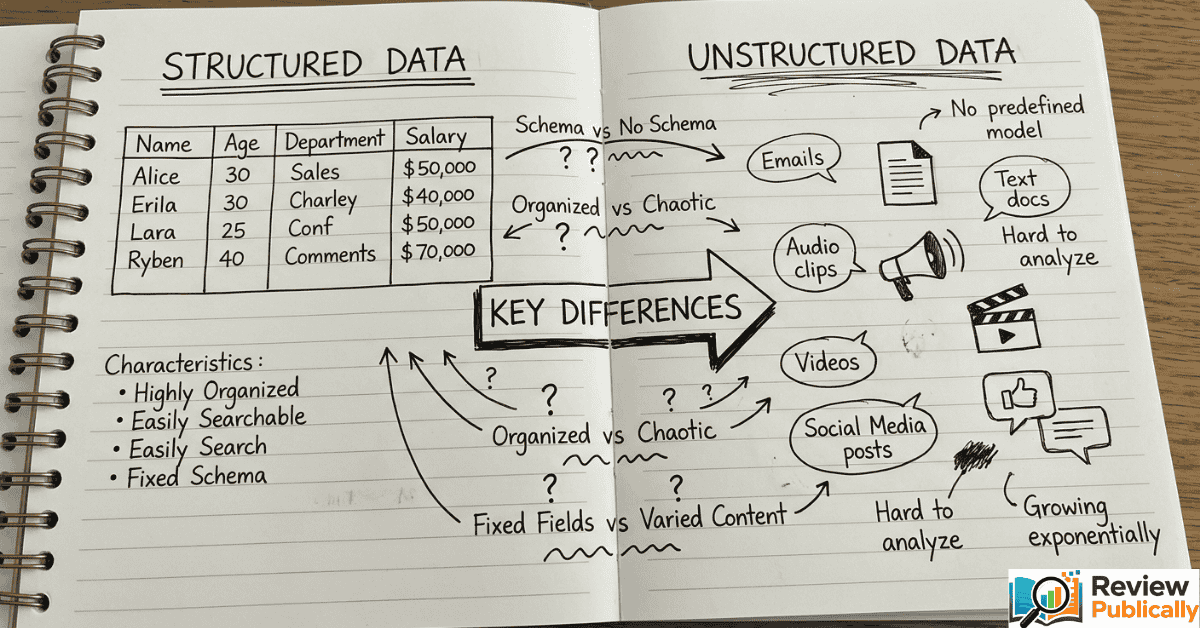
Structured data is highly organized and stored in a predefined format, typically using rows and columns within relational databases.
Because it follows a fixed schema, structured data is easy to search, query, filter, and analyze using traditional data management tools.
Example
Customer records stored in a SQL database containing names, email addresses, phone numbers, and purchase histories.
Common Use Cases
- Business intelligence dashboards
- Financial reporting
- Customer relationship management systems
- SQL-based analytics
Characteristics
- Predefined schema
- Highly organized
- Easy to query and analyze
- Stored in relational databases
Unstructured Data
Unstructured data does not follow a predefined schema or fixed format. It is often more complex and significantly larger in volume than structured data.
Most of the world's data today is unstructured, making it a major focus of artificial intelligence and machine learning applications.
Example
Images, videos, audio recordings, emails, social media posts, and text documents.
Common Use Cases
- Natural language processing (NLP)
- Computer vision systems
- Recommendation engines
- Generative AI applications
Characteristics
- No predefined structure
- Large data volumes
- Difficult to process using traditional databases
- Requires advanced machine learning techniques
Semi-Structured Data
Semi-structured data falls between structured and unstructured data. Although it does not follow a rigid schema, it contains organizational elements such as tags, metadata, or key-value pairs.
This additional structure makes semi-structured data easier to manage and analyze compared to fully unstructured information.
Example
JSON files, XML documents, API responses, and NoSQL database records.
Common Use Cases
- Web applications
- Cloud computing systems
- Data integration pipelines
- API communication
Characteristics
- Flexible format
- Contains metadata or tags
- Easier to organize than unstructured data
- Widely used in modern applications
Types of Data Based on Nature
Another important way to classify data is by its nature. This classification focuses on whether the data describes qualities and characteristics or represents measurable numerical values.
Nature-based classification divides data into two major categories:
- Qualitative Data
- Quantitative Data

Qualitative Data
Qualitative data is descriptive, categorical, and non-numerical. It focuses on qualities, opinions, behaviors, experiences, and characteristics rather than measurable quantities.
Organizations frequently use qualitative data to understand customer preferences, employee feedback, user experiences, and market sentiment.
Examples of Qualitative Data
- Customer reviews
- Survey responses
- Product feedback
- Colors and categories
- User opinions
Types of Qualitative Data
Nominal Data
Nominal data represents categories without any meaningful order or ranking.
Examples: Gender, colors, countries, product categories.
Ordinal Data
Ordinal data represents categories that have a logical order or ranking.
Examples: Customer satisfaction ratings, education levels, competition rankings.
/*Qualitative data helps organizations understand the “why” behind customer behavior and business outcomes.
*/
Quantitative Data
Quantitative data is numerical and measurable. It can be counted, calculated, and analyzed using mathematical and statistical techniques.
This type of data forms the foundation of most machine learning models, forecasting systems, and business analytics platforms.
Examples of Quantitative Data
- Revenue and profit
- Website traffic
- Number of customers
- Temperature measurements
- Product sales
Types of Quantitative Data
Discrete Data
Discrete data consists of countable values that cannot be divided into smaller meaningful units.
Examples: Number of students, number of orders, number of website visitors.
Continuous Data
Continuous data consists of measurable values that can take any value within a range.
Examples: Height, weight, time, distance, temperature.
Qualitative vs Quantitative Data
Although both categories are valuable in analytics, they serve different purposes and require different analysis methods.
| Feature | Qualitative | Quantitative |
|---|---|---|
| Type | Descriptive | Numerical |
| Examples | Reviews, opinions, feedback | Sales, revenue, users |
| Subtypes | Nominal, Ordinal | Discrete, Continuous |
| Primary Purpose | Understanding behavior | Measurement and analysis |
| Analysis Method | Categorization | Mathematical and statistical |
Types of Data in Statistics
In statistics, data is further classified based on measurement scales. Understanding these classifications helps analysts choose appropriate statistical methods and visualization techniques.
Nominal Data
Nominal data represents categories without any inherent order.
Examples: Gender, blood groups, countries.
Ordinal Data
Ordinal data contains categories with a meaningful ranking.
Examples: Satisfaction levels, rankings, grades.
Interval Data
Interval data consists of numerical values with equal intervals between measurements but no true zero point.
Examples: Temperature in Celsius or Fahrenheit.
Ratio Data
Ratio data contains equal intervals and a meaningful zero value, making it suitable for advanced mathematical operations.
Examples: Height, weight, income, age.
| Type | Order | Equal Intervals | True Zero |
|---|---|---|---|
| Nominal | No | No | No |
| Ordinal | Yes | No | No |
| Interval | Yes | Yes | No |
| Ratio | Yes | Yes | Yes |
Types of Data in Research
In academic studies, market research, and business investigations, data is commonly classified according to its source and collection method.
Primary Data
Primary data is collected directly by researchers for a specific purpose.
- Surveys
- Interviews
- Experiments
- Questionnaires
Secondary Data
Secondary data is collected from existing sources and reused for analysis.
- Government reports
- Research papers
- Public databases
- Industry publications
Experimental Data
Data collected under controlled conditions to test hypotheses and measure outcomes.
Observational Data
Data collected by observing events, individuals, or systems without direct intervention.
Types of Big Data in Data Science
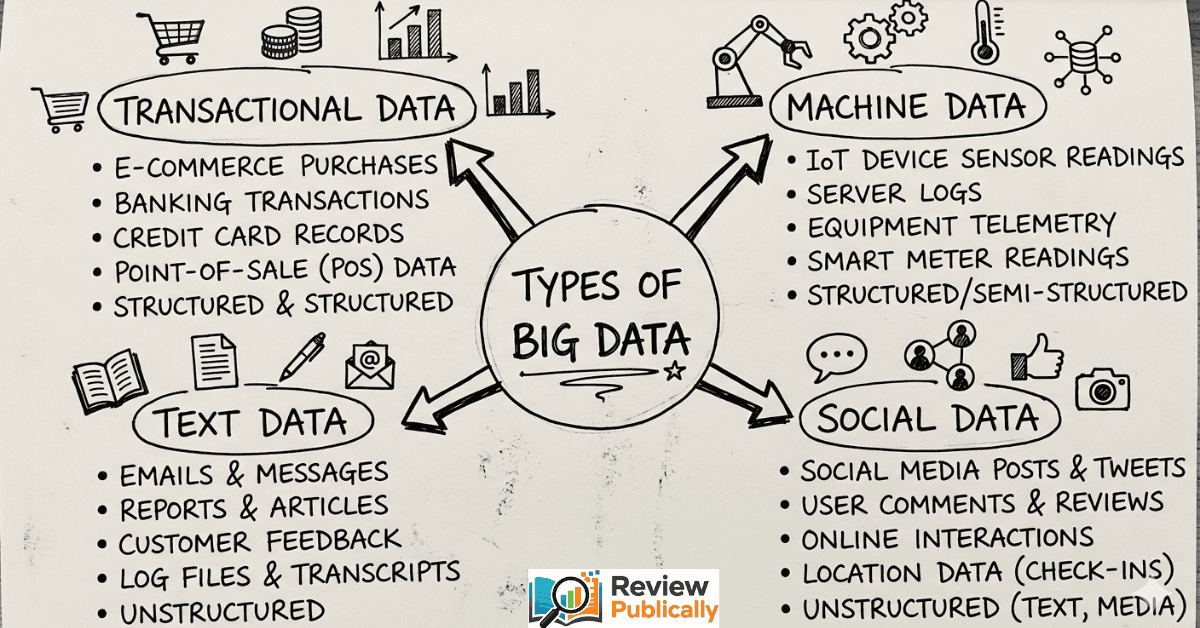
Modern organizations generate massive amounts of information every day. This large-scale information is commonly referred to as big data.
Big data powers recommendation systems, predictive analytics, fraud detection, healthcare research, and artificial intelligence applications.
Transactional Data
Transactional data records business activities and financial operations.
Examples: Purchases, payments, invoices, banking transactions.
Machine Data
Machine-generated data comes from devices, sensors, and automated systems.
Examples: IoT sensors, server logs, industrial equipment.
Social Data
Social data originates from online communities and social media platforms.
Examples: Comments, likes, shares, posts, interactions.
Text Data
Text data includes written content generated by people and systems.
Examples: Emails, documents, chat messages, articles, customer support tickets.
The 3Vs of Big Data
Big data is commonly defined by three core characteristics known as the 3Vs of Big Data.
Volume
Refers to the enormous quantity of data generated and stored by organizations.
Variety
Refers to the different formats of data, including text, images, audio, video, and structured records.
Velocity
Refers to the speed at which data is generated, transmitted, and processed.
/*The combination of volume, variety, and velocity is what makes big data both challenging and extremely valuable for modern organizations.
*/
Data Classification in Data Science
Data classification is the process of organizing information into categories based on its characteristics, structure, source, and intended use. Proper classification helps data scientists choose the right storage systems, analysis methods, and machine learning techniques.
Without proper classification, organizations often struggle with data quality issues, inefficient analytics, and poor decision-making.
Common Data Classification Methods
- By Structure: Structured, Unstructured, Semi-Structured
- By Nature: Qualitative, Quantitative
- By Source: Primary, Secondary
- By Measurement: Nominal, Ordinal, Interval, Ratio
- By Scale: Big Data Categories
/*Effective data classification improves analysis accuracy, data governance, compliance, and business intelligence outcomes.
*/
Complete Overview of Data Types
The following table summarizes the major categories of data commonly used in data science, statistics, research, and analytics.
| Category | Types |
|---|---|
| Structure-Based | Structured, Unstructured, Semi-Structured |
| Nature-Based | Qualitative, Quantitative |
| Statistical | Nominal, Ordinal, Interval, Ratio |
| Measurement | Discrete, Continuous |
| Research | Primary, Secondary, Experimental, Observational |
| Big Data | Transactional, Machine, Social, Text |
Real-World Example of Data Types in Data Science
To better understand how different data types work together, consider an e-commerce platform such as Amazon or Shopify.
| Data Type | Example |
|---|---|
| Structured Data | Customer database records |
| Unstructured Data | Product images and videos |
| Semi-Structured Data | API responses and JSON files |
| Quantitative Data | Sales revenue and order counts |
| Qualitative Data | Customer reviews and feedback |
| Machine Data | Server logs and application metrics |
| Social Data | Comments, shares, and user engagement |
Modern organizations rarely work with only one type of data. Instead, successful analytics systems combine multiple data types to generate comprehensive business insights.
Why Understanding Data Types Is Important
Understanding data types is one of the foundational skills required in data science, machine learning, business analytics, and research.
Choose the Right Tools
Different data types require different storage systems, databases, and analytical platforms.
Improve Accuracy
Proper data classification reduces errors and improves the reliability of analysis results.
Support Machine Learning
Machine learning models depend on correctly prepared and categorized data.
Better Decision-Making
Well-organized data helps businesses identify opportunities, risks, and trends more effectively.
Frequently Asked Questions
What are the two main types of data?
The two primary types of data are qualitative data and quantitative data. Qualitative data is descriptive, while quantitative data is numerical and measurable.
What are examples of quantitative data?
Examples include revenue, sales figures, number of users, temperature, height, weight, and website traffic metrics.
What is data classification?
Data classification is the process of organizing information into categories based on structure, source, nature, or measurement scale.
What are types of data in statistics?
Statistical data types include nominal, ordinal, interval, and ratio data.
What are different types of datasets?
Common dataset types include structured, unstructured, semi-structured, qualitative, quantitative, and big data datasets.
What are the main types of data in data science?
The main categories are structured, unstructured, semi-structured, qualitative, quantitative, statistical, research, and big data types.
What is structured vs unstructured data?
Structured data follows a predefined format such as tables, while unstructured data includes content like images, videos, and documents without a fixed schema.
What is discrete vs continuous data?
Discrete data contains countable values, whereas continuous data consists of measurable values that can exist within a range.
What is nominal vs ordinal data?
Nominal data contains categories without order, while ordinal data includes categories with a logical ranking or hierarchy.
What are types of data in research?
Research data includes primary data, secondary data, experimental data, and observational data.
Why is data classification important?
Proper classification improves data quality, analytics accuracy, machine learning performance, and business decision-making.
Conclusion
Understanding the different types of data in data science is essential for anyone working with analytics, artificial intelligence, machine learning, or business intelligence. Data serves as the foundation for every modern decision-making process, but its value depends heavily on how it is classified, stored, and analyzed.
From structured databases and semi-structured API responses to unstructured images, videos, and social media content, each category of data presents unique opportunities and challenges. Similarly, understanding qualitative and quantitative data helps analysts select appropriate research methods and statistical techniques for extracting meaningful insights.
As organizations continue generating massive amounts of information, knowledge of statistical data types, research classifications, and big data concepts becomes increasingly important. Professionals who understand these distinctions can build more accurate analytical models, improve machine learning outcomes, and make better business decisions.
Whether you're a student beginning your data science journey or an experienced analyst working with large-scale systems, mastering data classification is a fundamental skill that will help you unlock the full potential of data-driven decision-making.
References
- Syracuse University — Understanding the Types of Data in Data Science
- GeeksforGeeks — Data and Its Types
- GUVI — Types of Data in Data Science: Definitions, Examples, and Applications
- Medium — The Complete Guide to Data Types in Data Science
- IABAC — What Are the Types of Data in Data Science?