Structured vs Unstructured Data: Key Differences, Examples & Use Cases (2026)

// outline
Most data in the world today isn’t neatly organized in spreadsheets—it’s messy, complex, and growing fast. From social media posts to videos and emails, businesses are drowning in information. That’s where understanding structured vs unstructured data becomes critical.
If you’ve ever wondered why some data is easy to analyze while other data requires AI and machine learning, this guide breaks it down in the simplest way possible. By the end, you’ll clearly understand the difference, real-world examples, and when to use each type.
What is Structured vs Unstructured Data?
Structured Data
Structured data is organized into rows and columns with a predefined schema, making it easy to store and analyze.
Unstructured Data
Unstructured data has no fixed format and includes content like videos, images, emails, and documents.
Video Explanation: Structured vs Unstructured Data
Video Credit: Bernard Marr
Key Differences Between Structured and Unstructured Data
- Structured data follows a fixed schema.
- Unstructured data has no predefined format.
- Structured data is stored in databases.
- Unstructured data is stored in data lakes.
- Structured data is easy to analyze using SQL.
- Unstructured data requires AI and machine learning.
Structured vs Unstructured Data
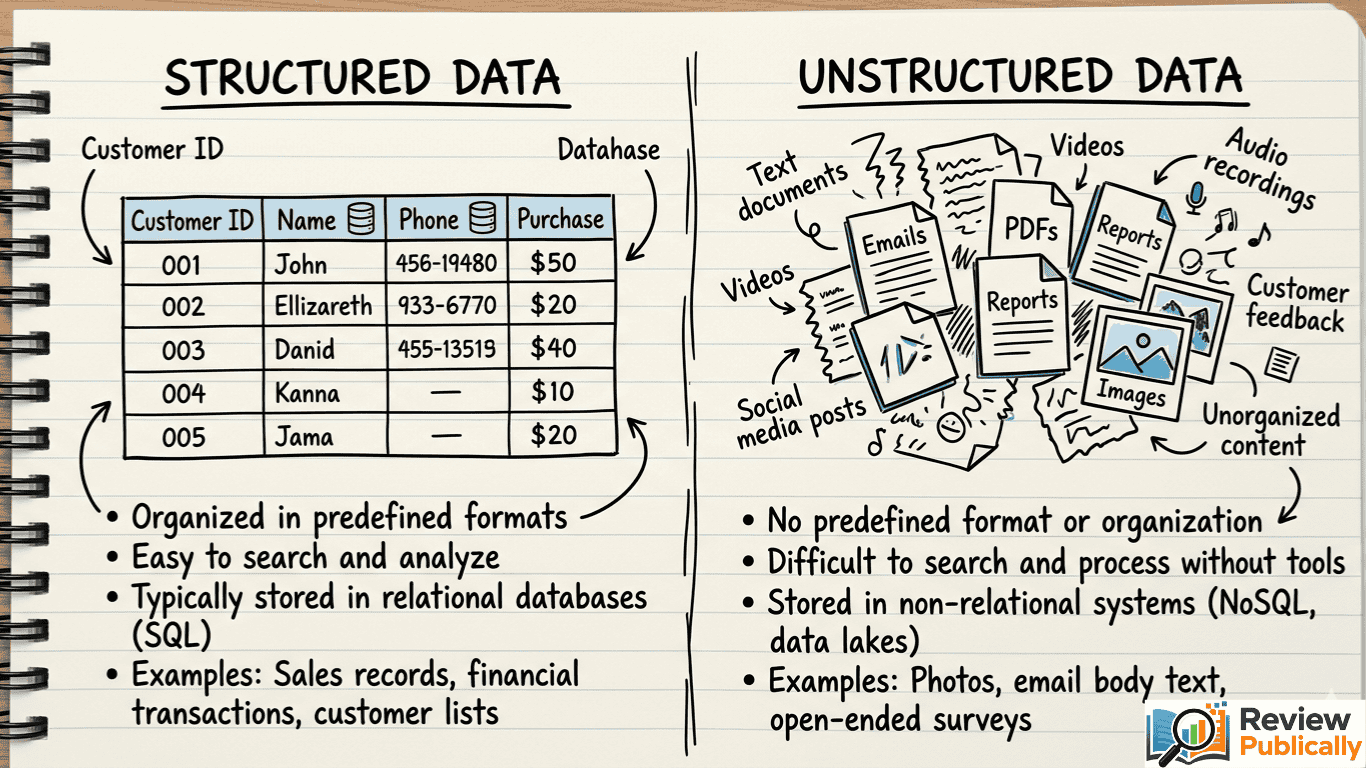
| Feature | Structured Data | Unstructured Data |
|---|---|---|
| Format | Fixed schema | No fixed format |
| Storage | Databases | Data lakes |
| Analysis | SQL | AI/ML |
| Examples | Tables, spreadsheets | Videos, emails |
| Flexibility | Low | High |
What is Structured Data?
Structured data is highly organized and stored in relational databases.
Examples of Structured Data
- Customer records
- Financial transactions
- Inventory systems
- Excel spreadsheets
What is Unstructured Data?
- Videos and images
- Emails and PDFs
- Social media posts
- Audio files
This type of data requires AI and machine learning for analysis.
Is SQL Structured or Unstructured Data?
SQL is used to manage and analyze structured data stored in relational databases. It is not designed for unstructured data, which requires advanced processing tools.
Is CSV Structured or Unstructured?
CSV files are considered structured data because they follow a tabular format with rows and columns, even though they are simple text files.
Is Excel Data Structured or Unstructured?
Excel data is structured data because it is organized into rows, columns, and predefined fields.
Does ChatGPT Use Unstructured Data?
AI systems like ChatGPT primarily work with unstructured data such as text, documents, and conversations. This data is processed using machine learning and natural language processing.
Structured vs Unstructured Data in Machine Learning (AI Use Cases)
- Structured data → used in predictive models and analytics
- Unstructured data → used in NLP, image recognition, AI
- Modern AI systems combine both for better results

Is Data Warehouse Structured or Unstructured?
A data warehouse stores structured data, while a data lake stores unstructured data. Many companies use both together.
Challenges of Structured vs Unstructured Data
Structured Data Challenges
- Schema limitations
- Complex relationships
- Difficult scaling
Unstructured Data Challenges
- Storage size
- Processing complexity
- Requires AI tools
When to Use Structured vs Unstructured Data
Use Structured Data When:
- You need fast queries
- Data is organized
- Working with numbers
Use Unstructured Data When:
- Data is complex
- Working with media/content
- Need deeper insights
What is the Difference Between Structured and Unstructured Data?
Structured data is organized in a predefined format such as tables, while unstructured data has no fixed structure and includes videos, images, and text. Structured data is easy to analyze, whereas unstructured data requires advanced tools like AI.
Frequently Asked Questions
What are examples of unstructured data?
Videos, emails, social media posts, audio files, and documents.
What are two examples of structured data?
Spreadsheets and relational databases.
Why is unstructured data harder to analyze?
Because it lacks a predefined format and requires AI tools.
What is semi-structured data?
Data like JSON or XML that has partial organization.
Which is better: structured or unstructured data?
Both are important. Structured data is easier, while unstructured data is richer.
How much data is unstructured?
Around 80–90% of global data is unstructured.
References
- AWS: What’s the Difference Between Structured Data and Unstructured Data?
- Databricks: Structured vs Unstructured Data
- Geeks for Geeks: Difference between Structured, Semi-structured and Unstructured Data
- Integrate.io: Structured vs Unstructured Data – 5 Key Differences
- IBM: Structured vs. Unstructured Data